
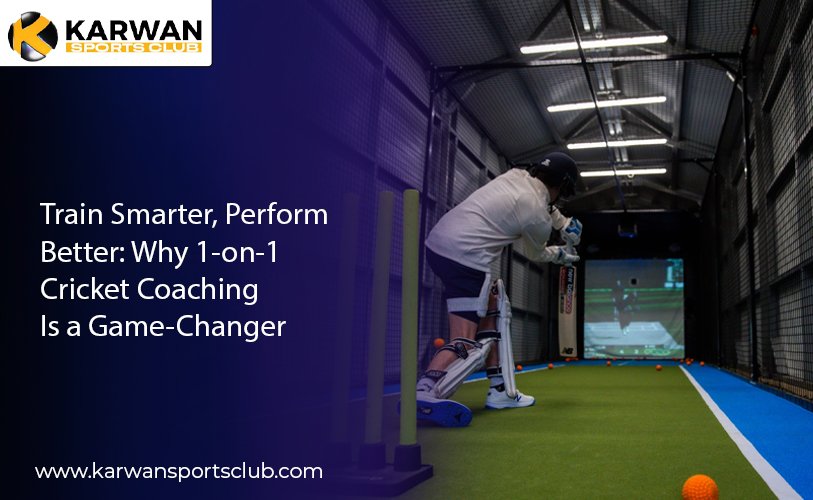
That single idea — undivided attention translating into faster, more lasting improvement — is really the whole case for personalized cricket coaching. But there’s a lot more worth unpacking, from what a private session actually looks like to how to tell if it’s the right investment for you or your child. Let’s get into it.
What Makes 1-on-1 Cricket Coaching Different From Group Training
Group nets are great for match simulation, camaraderie, and building general fitness. But they were never designed to fix a specific technical flaw. When a coach is managing ten batters rotating through one net, they might catch a glaring mistake, but they rarely have time to explain why it’s happening or walk you through the correction until it sticks.
With one-on-one cricket coaching, the entire session is built around you. The coach watches every ball you face or bowl, notices patterns you can’t see yourself — like a bat coming down at an angle, or a bowling action that loses rhythm under pressure — and adjusts the plan on the spot. This is the essence of personalized cricket coaching: it isn’t a fixed curriculum applied to everyone equally, it’s a program that bends around your specific strengths, weaknesses, and goals.
The Feedback Loop Is Instant
In a group setting, feedback might come minutes after a mistake, if it comes at all. In a private session, the correction happens on the very next ball. That tight feedback loop is one of the biggest reasons personalized training accelerates skill acquisition — you’re not repeating a flawed movement pattern twenty times before someone notices.
Training Plans Actually Fit the Player
A twelve-year-old working on basic batting stance needs a completely different plan from a club-level all-rounder trying to add a slower ball to their bowling arsenal. One-on-one cricket coaching lets a coach design a plan around age, current skill level, physical development, and even the player’s own goals — whether that’s making a school team, sharpening for a league season, or simply falling in love with the game.
Who Actually Benefits From Personalized Cricket Coaching
There’s a myth that private coaching is only for elite academy players. In reality, it helps almost anyone who’s serious about improving, at any stage.
Beginners benefit because bad habits are far easier to prevent than to fix later. A coach who’s watching closely can stop a flawed grip or a chicken-wing bowling action before it becomes muscle memory.
Intermediate players often hit a wall where general practice stops producing results. This is usually where a technical gap — a weakness against spin, a tendency to lose shape at the crease under pace — needs individual diagnosis rather than another round of generic drills.
Advanced and competitive players use personalized cricket coaching to fine-tune small margins: shot timing, decision-making under match pressure, or building a second bowling variation. At this level, tiny adjustments produce outsized results, and those adjustments are almost impossible to make in a crowded group setting.
Parents of young cricketers also find real value here, mostly because a private coach can track a child’s technical and physical development over months, rather than seeing them for one session and moving on.
The Core Benefits of 1-on-1 Cricket Coaching
Faster Technical Correction
Cricket technique is built on small mechanical details — bat swing path, head position, seam position at release, follow-through. These details are hard to self-diagnose and even harder to fix without someone watching closely. A dedicated coach catches these issues immediately and gives corrections that are specific rather than generic.
Mental Game and Match Awareness
Good coaching goes beyond mechanics. A private coach can work through situational awareness with you — how to read a bowler’s length earlier, how to manage nerves chasing a target, how to reset after getting out cheaply. This kind of mental coaching is difficult to deliver in a group because it requires a real conversation, not just repetition.
A Program Built Around Your Schedule and Goals
Personalized cricket coaching also means personalized scheduling. Sessions can be built around exam periods, off-season conditioning, or a specific tournament date. The training plan flexes with your calendar instead of forcing you to fit into a fixed academy timetable.
Confidence That Comes From Real Improvement
There’s a psychological side to this too. When a player sees measurable progress — a cleaner cover drive, a more consistent yorker, better shot selection against spin — confidence follows naturally. That confidence often matters as much as the technical gain itself when it comes to actual match performance.
What a Typical 1-on-1 Cricket Coaching Session Looks Like
Most private sessions follow a similar rhythm, even though the specifics shift depending on the player.
- A short warm-up and mobility check — coaches often use this time to observe posture and movement patterns before any bat or ball is involved.
- A skills assessment — for a new player, the coach will spend part of the first session simply watching: how you grip the bat, how you load into your bowling action, how you move your feet.
- Focused drilling on one or two specific areas — rather than trying to fix everything at once, good coaches isolate one or two problems per session so the correction actually sticks.
- Situational practice — simulating match scenarios like defending the last over, or building an innings after a slow start.
- A quick debrief — a few minutes of feedback on what worked, what to practice before the next session, and what the plan looks like going forward.
This structure is very different from a two-hour group net session where a player might face fifty balls total and get almost no individual feedback in between.
Choosing the Right Setting for Personalized Cricket Coaching
The coach matters, obviously — but so does the environment. Bowling machines, proper practice pitches, video analysis tools, and enough space to work on both batting and bowling without interruption all make a measurable difference in how much a player can get out of a session.
This is one of the reasons serious players and parents look for facilities that are actually built for cricket training rather than a shared multi-purpose field squeezed in between other sports. A well-maintained cricket ground with proper nets, consistent pitch conditions, and enough room for full-session drilling lets a coach run a much more complete program — everything from technical net sessions to full-scenario practice matches.
If you’re exploring options locally, it’s worth visiting a facility in person and asking about their coaching structure directly. At Karwan Sports Club, for example, players training in dedicated cricket grounds get access to a setup designed specifically for both individual coaching and match-level practice, which matters a lot once you move past the basics and start working on situational play. Facilities based in Ajman have also become a natural hub for cricketers across the UAE looking for consistent training environments close to home.
How to Get the Most Out of Private Cricket Coaching
Personalized coaching isn’t magic — it still requires the player to show up with the right mindset. A few things tend to separate players who improve quickly from those who don’t:
- Be specific about your goals. “I want to get better” is harder to coach than “I want to stop getting out to the short ball” or “I want a more consistent length as a bowler.”
- Practice between sessions. A weekly one-hour session works best when it’s reinforced with independent practice, even something as simple as shadow batting or shadow bowling at home.
- Track progress honestly. Video review, even on a phone, helps players see changes over time that are hard to notice day to day.
- Be patient with technical changes. Rebuilding a bowling action or batting stance takes weeks of repetition, not one session. Trust the process the coach lays out.
- Communicate openly with your coach. If something isn’t clicking, say so. Good coaches adjust their explanation rather than repeating the same instruction.
Is 1-on-1 Cricket Coaching Worth the Investment?
It’s a fair question, especially since private coaching typically costs more per hour than group sessions. But the value comparison isn’t really about the hourly rate—it’s about the rate of improvement per hour trained. A player who spends one focused hour a week on a specific weakness, with immediate correction, often improves faster than a player spending three hours a week in general group practice.
For serious junior cricketers aiming for school or club selection, for adult players trying to compete at a higher league level, or for anyone who’s felt genuinely stuck despite putting in the hours, personalized cricket coaching tends to pay for itself in confidence and results. It’s not about replacing team practice — it’s about complementing it with the kind of individual attention that turns raw effort into real, measurable skill.
Final Thoughts
Cricket rewards precision—in technique, in timing, and in decision-making—and precision is exactly what group coaching struggles to deliver. One-on-one cricket coaching closes that gap. It gives players a coach who’s watching only them, correcting only their mistakes, and building a plan around only their goals. Whether you’re a parent looking for the right start for your child, a club player chasing the next level, or someone simply rediscovering a love for the game, personalized coaching is one of the most reliable ways to train smarter and, in turn, perform better.